Strengthening mental health supports integration

The mental wellbeing of Ukrainians displaced to Sweden was supported using a peer-support group model developed by MIELI Mental Health Finland. Eleven groups were organised in 2025–2026 through a joint project involving Reach for Change, Help Ukraine Gothenburg (HUG) and MIELI Mental Health Finland.
Participants described the groups as providing a new and safe community, structure in their daily lives and practical ways to look after their mental wellbeing. Above all, the groups reduced feelings of loneliness by giving participants an opportunity to share their experiences, many for the first time since leaving Ukraine.
The TOIVO model supports mental health through practical activities
The Facilitating Refugee Integration through Dedicated Mental Health Support (FRID) project used the TOIVO peer-support group model, originally developed by MIELI Mental Health Finland for migrant communities in Finland. Each group was led by two trained facilitators who were also from Ukraine. Participants met once a week for eight sessions.
Each session combined a shared activity, such as cooking, exercise, a museum visit or creative activities, with guided reflection on the feelings prompted by the experience. The approach followed the principle “Act/Do – Feel – Reflect”. The model was adapted to the Swedish context and the specific needs of Ukrainian participants.
“It was a very important and emotional experience for me, because I realised how important community is for people to feel well. And how small steps and interventions can make such a huge difference to people’s wellbeing and support them in their everyday lives,” says Halyna Romanuik, TOIVO group facilitator, Gothenburg.
The mental health of people arriving from crisis-affected areas must be addressed
Since Russia’s full-scale invasion of Ukraine in 2022, around 49,000 Ukrainians have been granted temporary protection in Sweden. An earlier survey from 2024 by Help Ukraine Gothenburg found that more than half of respondents felt lonely and almost eight in ten experienced high levels of anxiety, an increase from 68 percent in 2023.
At the same time, access to support through the public healthcare system is often limited by long waiting times, a lack of services available in Ukrainian and complex pathways into the system.
“In the evaluation of the project, all participants confirmed that they had made at least one small change in their daily lives that contributed to improved wellbeing, and we saw the same positive effect among the facilitators. It is a clear demonstration of the power of the approach, when people are given the opportunity to support others, it also strengthens their own wellbeing,” says Mariya Melnyk, Project Manager, Help Ukraine Gothenburg.
Collaboration creates new forms of low-threshold support
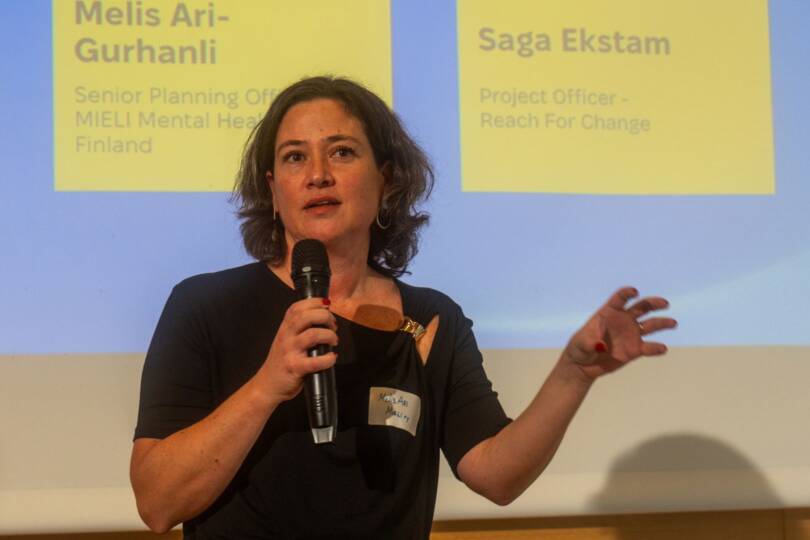
“Seeing the TOIVO model work just as well outside Finland, with a new target group and within a different welfare system, was incredibly rewarding and inspiring for us. It demonstrates the potential of the model and how it can be adapted to serve different needs. These are insights and knowledge that other countries and organisations can now build on,” says Melis Ari-Gurhanli, Senior Planning Officer, MIELI Mental Health Finland.
Reach for Change, HUG and MIELI Mental Health Finland hope that more organisations will adopt the model. The final report now being published has been designed as a practical guide for organisations interested in using the approach in their own work. The FRID project has been funded through the European Union’s ESF+ Social Innovation+ initiative and will formally conclude in October 2026.
“This project clearly shows what social innovation can achieve: new, accessible and low-threshold support tailored to the needs of a specific group, filling a gap that traditional healthcare often has limited capacity to address. But we could not have achieved this on our own. This is the result of bringing together our different areas of expertise and having the courage to build something new together,” says Saga Ekstam, Project Officer at Reach for Change.
Download the report
FRID in numbers
- 48,725 Ukrainians were registered in Sweden under the EU Temporary Protection Directive as of June 2026 (Eurostat).
- More than half of Ukrainian respondents in Sweden reported feeling lonely in a 2023 survey (HUG).
- 77 percent reported a high level of anxiety in 2024, up from 68 percent in 2023.
- 11 TOIVO peer-support groups were delivered between October 2025 and May 2026 across six municipalities: Gothenburg, Kungälv, Trollhättan, Helsingborg and Lund.
- 131 participants in total, with an average attendance rate of 75 percent.
- The project is funded through the EU’s ESF+ Social Innovation+ initiative and runs from April 2025 to October 2026.
Reach for Change is a global organisation that supports social entrepreneurs with skills, networks and funding to scale their social impact. Reach for Change’s vision is a world where everyone can shape their own future.
Help Ukraine Gothenburg (HUG) is a non-profit organisation that provides humanitarian and rescue aid to Ukraine and supports the social integration and mental health of Ukrainians living in Sweden.
MIELI Mental Health Finland is a non-profit, non-governmental organisation founded in 1897. Its mission is to promote mental health and prevent mental health problems. MIELI coordinates a nationwide network of crisis centres in Finland and works to promote the mental wellbeing of children, young people, adults and older people.
Contact us
Melis Ari-Gürhanli
Senior Planning Officer
Mental well-being and multicultural activities
+358 40 186 8122
etunimi.sukunimi@mieli.fi